


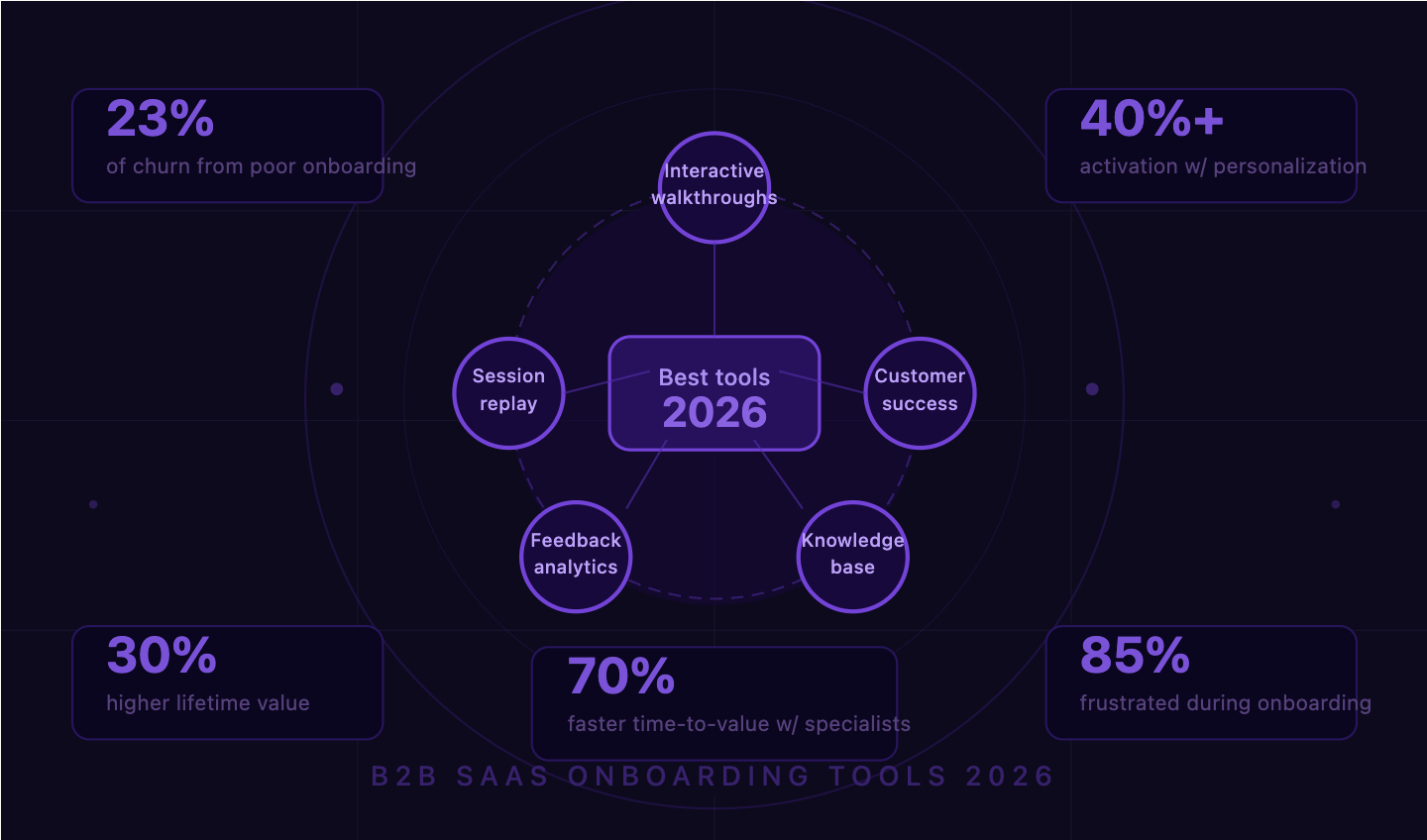


The B2B SaaS onboarding landscape has shifted dramatically over the past two years. What used to be a series of welcome emails and a product walkthrough video has become a sophisticated, data-driven process that can make or break customer retention. The numbers tell the story: poor onboarding contributes to roughly 23% of churn, which means nearly a quarter of your lost revenue traces back to those first critical interactions with your product. If you're searching for the best B2B SaaS onboarding tools in 2026, you're asking the right question at the right time. The tools available today are smarter, more integrated, and far more capable of delivering personalized experiences at scale. But the sheer volume of options can be paralyzing. This guide breaks down the ten strongest categories of tools - from interactive walkthroughs to sentiment analysis platforms - so you can build an onboarding stack that actually moves the needle on activation and retention.
Onboarding in 2026 looks nothing like it did even three years ago. The old playbook - assign a CSM, schedule a kickoff call, send a Loom video - still exists, but it's been layered with technology that can read user behavior in real time and respond accordingly. Companies that treat onboarding as a one-size-fits-all checklist are losing to competitors who treat it as a dynamic, personalized journey.
The biggest shift? Onboarding is no longer a phase. It's a continuous process that extends well beyond the first login. Product teams now think about onboarding in terms of feature adoption curves, not just initial setup. And the tools reflect that thinking: they're designed to re-engage users at every stage, not just day one.
B2B SaaS companies with dedicated onboarding specialists see 70% faster Time-to-Value, but not every company can afford a team of specialists for every account. That's where the right technology fills the gap, enabling smaller teams to deliver white-glove experiences at scale.
AI isn't a buzzword in onboarding anymore - it's the engine. The best tools in 2026 use machine learning models trained on thousands of user journeys to predict what a specific user needs next. Instead of showing every new user the same five-step tour, these systems analyze role, industry, company size, and in-app behavior to serve up the most relevant guidance.

Think of it this way: a marketing manager logging into your analytics platform for the first time needs a completely different experience than a data engineer. AI-driven onboarding tools can detect these differences within the first few clicks and adjust the flow automatically. Some platforms now offer dynamic path branching, where the onboarding sequence literally rewrites itself based on what the user does (or doesn't do) in real time.
The impact is measurable. Companies using AI-personalized onboarding are reporting activation rates that push well above the industry average. Top-quartile products achieve a 40%+ activation rate, and personalization is a major reason why.
PLG isn't new, but its dominance in 2026 is hard to overstate. The model - where the product itself drives acquisition, activation, and expansion - has reshaped how companies think about onboarding entirely. In a PLG motion, onboarding isn't something the customer success team owns. It's baked into the product itself.
This matters for tool selection because PLG companies need onboarding tools that integrate directly into the product experience, not alongside it. They need in-app guidance, contextual help, and self-service resources that let users discover value without ever scheduling a call. The best PLG onboarding stacks reduce friction at every turn: fewer clicks to the "aha moment," fewer support tickets, fewer reasons to bounce.
The data supports this approach. Great onboarding leads to 30% higher customer lifetime values, and PLG companies tend to capture that uplift more consistently because their onboarding is embedded in the product experience rather than bolted on. If your company is transitioning from a sales-led to a product-led or hybrid model, your onboarding tooling needs to evolve with that strategy.
Interactive walkthroughs have matured significantly. The early versions were clunky, often breaking when the UI changed, and they felt more like PowerPoint presentations than genuine product guidance. The 2026 generation of walkthrough tools is different: they're responsive, adaptive, and built to handle the complexity of enterprise B2B products with dozens of modules and user roles.
The best platforms in this category share a few traits. They work without requiring engineering resources to build or maintain flows. They support branching logic so different users see different paths. And they integrate with your analytics stack so you can measure exactly where users drop off and why.
Two capabilities stand out as particularly valuable this year: no-code in-app guidance and contextual tooltips.
B2B products are inherently complex. You're not onboarding someone to a to-do list app - you're guiding them through multi-step workflows that might involve integrations, team permissions, and custom configurations. No-code walkthrough builders have become essential because they let product and growth teams iterate on onboarding flows without filing engineering tickets.
The leading tools in this space - platforms like Userpilot, Appcues, and Chameleon - now support conditional logic that rivals what you'd get from custom code. You can trigger a walkthrough only when a user matches specific criteria: their plan tier, their role, whether they've completed a prerequisite action, or even how many times they've visited a particular page.
What makes these tools especially powerful for B2B is their ability to handle multi-user onboarding. In a B2B context, you're rarely onboarding one person. You're onboarding a team, and different team members need different guidance. The best no-code platforms let you create role-specific flows from a single dashboard, which saves an enormous amount of time compared to building custom onboarding logic in your own codebase.
Tooltips and hotspots might sound simple, but they're among the highest-ROI onboarding investments you can make. The reason is straightforward: most B2B products have features that users never discover on their own. A well-placed tooltip that appears at the right moment - say, when a user hovers over an unfamiliar icon or lands on a page for the first time - can be the difference between a user who finds value and one who churns.
The 2026 generation of tooltip tools goes beyond static pop-ups. They use behavioral triggers to surface tips only when they're relevant. If a user has already used a feature ten times, they don't need a tooltip explaining it. Smart tooltip systems suppress guidance for experienced users and amplify it for new ones.
Hotspots - those small, pulsing indicators that draw attention to specific UI elements - are particularly effective for feature discovery after the initial onboarding phase. They're less intrusive than full walkthroughs but more noticeable than passive documentation. Tools like Pendo and Whatfix have refined their hotspot functionality to include A/B testing, so you can measure whether a hotspot actually drives feature adoption or just annoys people.
Onboarding doesn't end when the user completes a product tour. The customer success tools that manage the full lifecycle - from first login through renewal - have become critical components of any serious onboarding stack. These platforms sit at the intersection of product data, CRM data, and support data, giving teams a unified view of customer health.
The two capabilities that matter most here are predictive churn analytics and automated milestone tracking.
Over 85% of clients experience frustration during onboarding, and most of them won't tell you about it. They'll just stop logging in. Predictive analytics tools solve this by flagging at-risk accounts before the damage is done.
Platforms like Gainsight, Totango, and ChurnZero have invested heavily in their predictive models over the past year. These tools ingest product usage data, support ticket volume, NPS scores, and engagement patterns to generate health scores that actually mean something. The best implementations go beyond a simple red/yellow/green dashboard - they recommend specific interventions based on the risk signals they detect.
For example, if a new account hasn't completed their integration setup within the first week, the system might automatically trigger a personalized email from the CSM with a link to a guided setup wizard. If a power user suddenly stops logging in, it might flag the account for a proactive check-in. These automated responses mean your team spends less time monitoring dashboards and more time having meaningful conversations with customers who need them.
Every B2B product has a set of milestones that correlate with long-term retention. Maybe it's completing the initial data import. Maybe it's inviting three team members. Maybe it's running their first report. Whatever those milestones are, tracking them manually across hundreds or thousands of accounts is impossible.
Automated milestone tracking tools let you define your success criteria once and then monitor every account's progress against those benchmarks in real time. The best tools in this category integrate directly with your product's event data, so there's no manual logging required. When a user hits a milestone, the system can trigger a celebration message, unlock the next phase of onboarding, or notify the CSM.
What's changed in 2026 is the sophistication of milestone sequencing. Modern tools support branching milestone paths, where different customer segments have different success criteria. An enterprise account with a 90-day implementation timeline has different milestones than a self-serve SMB account that should reach value in 48 hours. The tools now accommodate that complexity without requiring custom development.
Self-service isn't optional anymore - it's expected. B2B buyers, especially in tech, want to solve problems on their own before reaching out to support. The knowledge base tools available in 2026 have evolved far beyond searchable FAQ pages. They're intelligent, context-aware systems that serve up the right information at the right time.
The best knowledge base platforms now integrate directly into the product UI. Instead of forcing users to open a new tab and search a help center, they surface relevant articles, videos, and guides inside the app based on what the user is currently doing. This contextual delivery dramatically reduces the friction between encountering a problem and finding the answer.
Traditional keyword-based search in knowledge bases has always been frustrating. Users don't search the way technical writers title articles. Someone looking for help with "connecting my Salesforce data" might not find the article titled "CRM Integration Configuration Guide."
AI-powered semantic search fixes this by understanding intent rather than matching keywords. Tools like Guru, Helpjuice, and Document360 now offer natural language search that interprets what users mean, not just what they type. Some platforms have integrated conversational AI that lets users ask questions in plain language and receive synthesized answers drawn from multiple knowledge base articles.
The impact on onboarding is significant. When new users can find answers instantly without leaving the product, they move through the onboarding process faster and with less frustration. Support ticket volume drops, CSM bandwidth increases, and users develop a habit of self-service that pays dividends long after onboarding is complete. For companies building their top B2B SaaS onboarding tools stack in 2026, a strong knowledge base with AI search capabilities is non-negotiable.
You can't improve what you don't measure, and you can't measure onboarding quality without listening to users. Feedback and sentiment analysis tools close the loop between what you think the onboarding experience is like and what users actually experience. The gap between those two perspectives is often wider than teams expect.
NPS surveys have been around forever, but the way they're deployed during onboarding has changed. Instead of sending a single NPS survey 30 days after signup, the best teams now deploy micro-surveys at specific onboarding milestones. Did the user just complete their first workflow? Ask them how it went. Did they just finish the setup wizard? Capture their sentiment while it's fresh.
Tools like Survicate, Refiner, and UserVoice specialize in these lightweight, in-app surveys that capture feedback without disrupting the user's flow. The key is timing and brevity: one to two questions, triggered by a specific action, appearing as a subtle slide-in rather than a modal that blocks the screen.
The data these micro-surveys generate is gold for onboarding optimization. When you can correlate specific onboarding steps with drops in sentiment, you know exactly where to focus your improvement efforts. A single poorly designed configuration screen that consistently generates negative feedback is a clear signal to redesign that step.
Survey data tells you how users feel. Session replay shows you what they actually did. The combination of these two data sources is incredibly powerful for identifying onboarding friction points.
Tools like FullStory, Hotjar, and LogRocket record user sessions so you can watch exactly how new users interact with your product during onboarding. Where do they hesitate? Where do they click the wrong button? Where do they rage-click in frustration? These tools now include AI-powered analysis that automatically surfaces sessions with high frustration signals, so you don't have to watch hundreds of recordings manually.
The most effective teams pair session replay data with their onboarding funnel metrics. If you see a 40% drop-off between step three and step four of your onboarding flow, session replays of users at that exact step will show you why. Maybe the CTA button is below the fold. Maybe the instructions are confusing. Maybe there's a loading issue that only affects certain browsers. You'd never discover these problems from analytics alone - you need to see the user's actual experience.
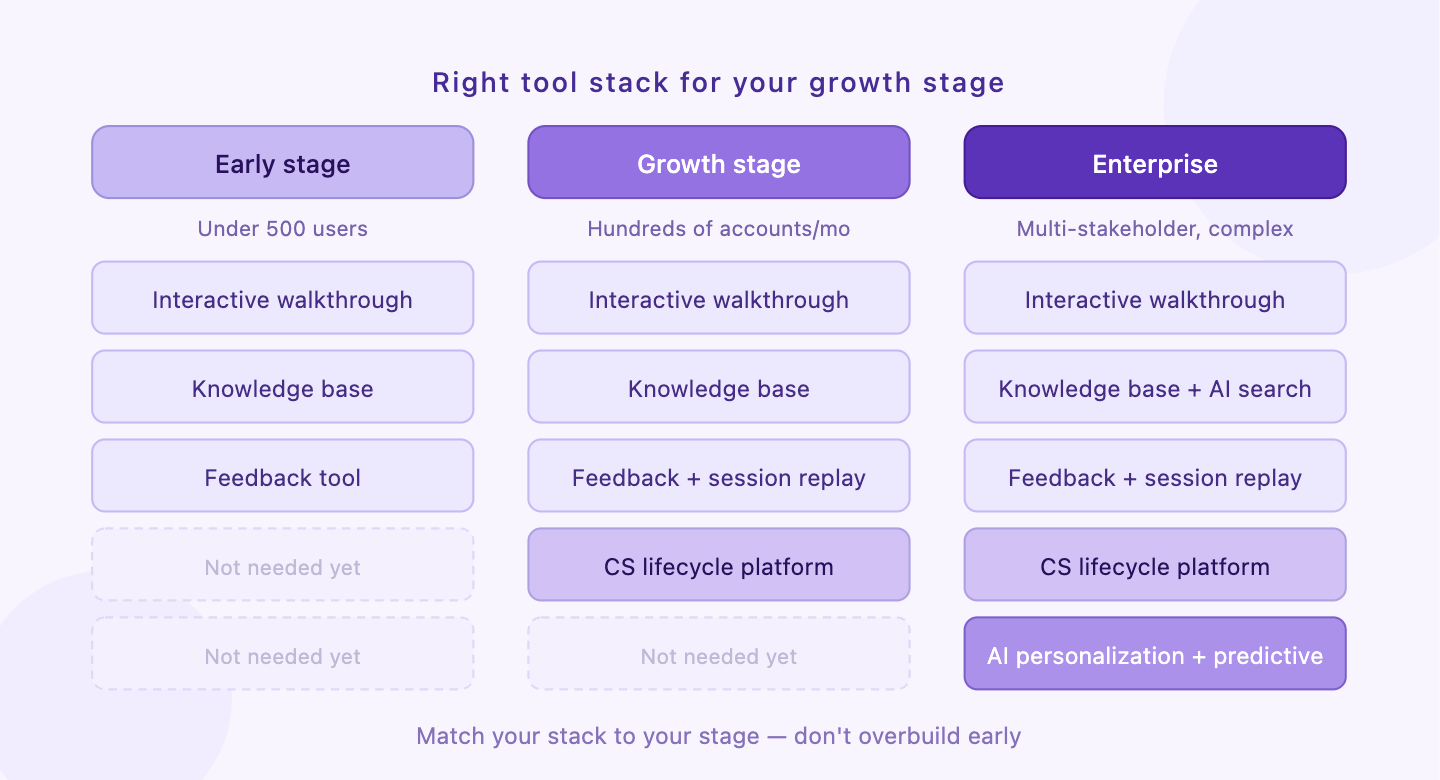
Not every company needs all ten categories of tools. Your stage of growth, your average contract value, and your onboarding model should dictate which tools you prioritize first.
Early-stage companies with fewer than 500 users should focus on three things: an interactive walkthrough tool, a basic knowledge base, and a feedback mechanism. That's enough to deliver a solid onboarding experience without overcomplicating your stack. You don't need predictive churn analytics when you can personally check in with every new account.
Growth-stage companies handling hundreds of new accounts per month need to layer in customer success platforms and session replay tools. At this scale, manual oversight breaks down, and you need automated systems to catch at-risk accounts and identify friction points across a large user base.
Enterprise companies with complex, multi-stakeholder onboarding processes benefit most from the full stack: AI-driven personalization, predictive analytics, automated milestone tracking, and integrated feedback loops. The investment is significant, but the payoff in retention and expansion revenue justifies it.
One mistake I see repeatedly: companies buying tools before defining their onboarding milestones and success metrics. No tool can fix an onboarding process that doesn't have clear goals. Before you evaluate any platform, answer these questions: What does successful onboarding look like for your product? What are the three to five actions that correlate with long-term retention? How long should onboarding take for each customer segment?
Once you have those answers, the tool selection becomes much clearer. You're not shopping for features - you're shopping for solutions to specific problems in your onboarding funnel.
If you're building or rethinking your onboarding strategy and want expert guidance on creating experiences that actually convert and retain users, Flow is an agency that specializes in exactly this: helping SaaS companies design onboarding flows and PLG motions that reduce churn and drive activation. Get in touch to see how they can help your team move faster.
The tools are better than they've ever been. The real question is whether your strategy is strong enough to use them well. Start with your goals, pick tools that serve those goals, and measure relentlessly. That's how you build onboarding that keeps customers around.


