Net revenue retention (NRR) is the percentage of recurring revenue you keep from your existing customers over a period, after upgrades, downgrades and cancellations, with new customers left out. Above 100%, your customer base grows on its own; below 100%, it shrinks, and new sales have to refill it before you grow at all. (In SaaS, NRR means net revenue retention. It isn't net reproduction rate, the population statistic that shares the abbreviation.)
This is the first guide in our revenue leak series, and the one the other four add up to. Revenue leaks at every stage between signup and renewal: in SaaS onboarding, at trial to paid, through SaaS churn and in missed expansion. Net revenue retention is where all of it shows up in one number.
What is net revenue retention?
Net revenue retention measures how much recurring revenue a fixed group of customers pays you at the end of a period compared with the start. Usually the period is 12 months and the group is every customer you had on day one.
Four things move it:
- Starting revenue: the monthly or annual recurring revenue (MRR or ARR) those customers paid at the start.
- Expansion: upgrades, extra seats, add-ons and usage growth from the same customers.
- Contraction: downgrades and fewer seats.
- Churned revenue: customers who cancel or don't renew.
New customers never count, even if they sign in the first week of the period. That's what makes NRR useful: it shows whether the customers you already have are getting more value over time, separate from how well sales and marketing are doing. You'll also see it called net dollar retention (NDR); it's the same metric.
What is the NRR formula?
The net revenue retention formula is:
NRR = (starting recurring revenue + expansion − contraction − churned revenue) ÷ starting recurring revenue × 100
Use the same customers on both sides and the same unit throughout: MRR or ARR, never a mix. One-off fees, such as setup or services, stay out.
How to calculate NRR: a worked example
The numbers below are illustrative, for a made-up company, to show the method.
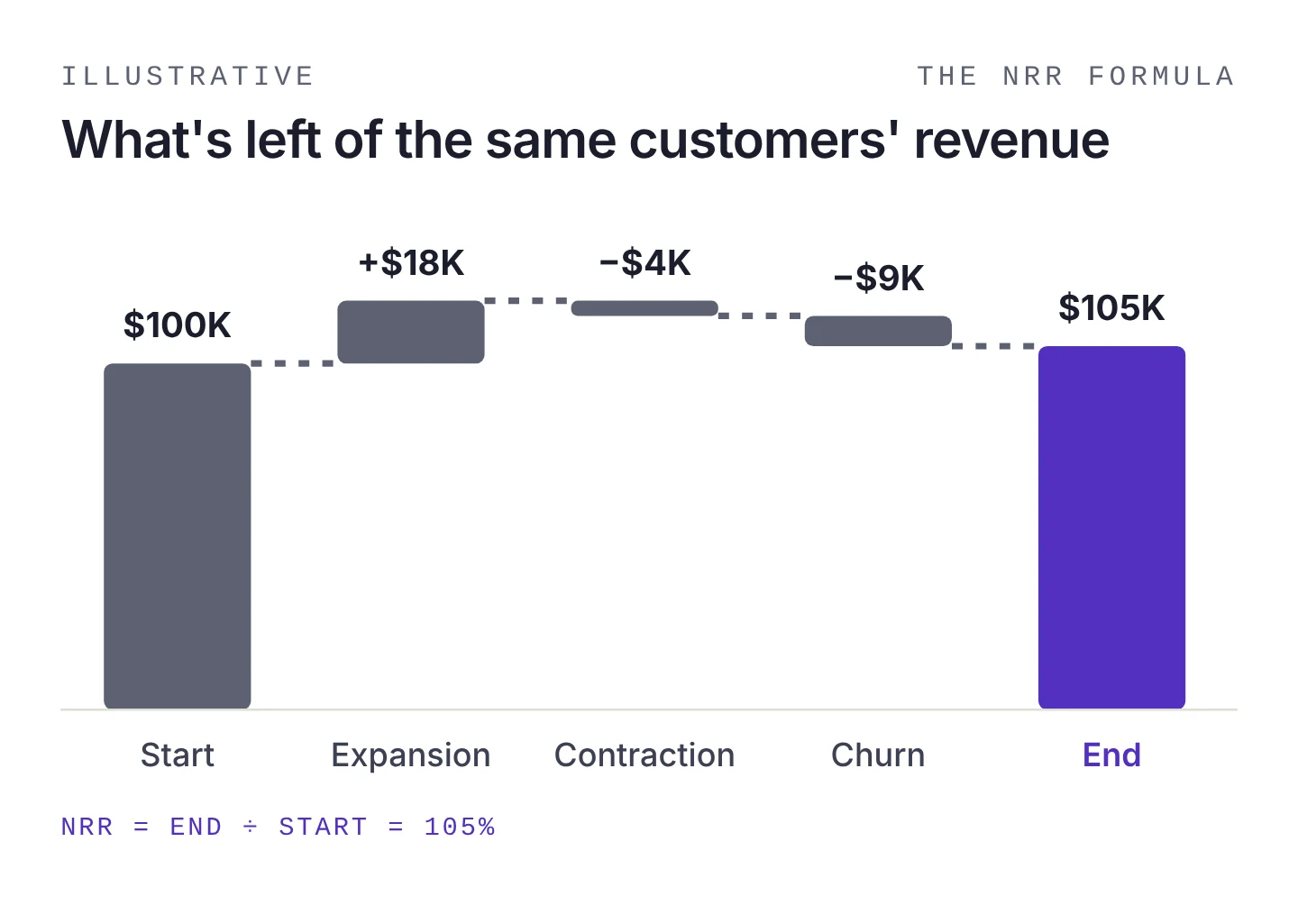
On January 1 your customers pay you $100,000 in MRR. Over the next 12 months, some of those same customers add seats and upgrade, some downgrade and some cancel. Customers who signed during the year are ignored.
| Part | Change in MRR | Running total |
|---|---|---|
| Starting MRR (January 1 customers) | $100,000 | |
| Expansion: upgrades, seats, add-ons | +$18,000 | $118,000 |
| Contraction: downgrades | −$4,000 | $114,000 |
| Churned revenue: cancellations | −$9,000 | $105,000 |
| Net revenue retention | $105,000 ÷ $100,000 = 105% |
The same customers pay you 5% more than a year ago, so the business would grow by 5% even if sales closed nothing new.
Three steps make the calculation repeatable:
- Freeze the group. List the customers active on the first day and their recurring revenue. That list doesn't change for the rest of the period.
- Pull their revenue on the last day. From billing, take what each of those customers pays now. A customer who cancelled pays $0.
- Divide. Their total now ÷ their total then × 100. If you also want the parts, classify each customer's change as expansion, contraction or churn.
Monthly or annual? Annual NRR on a 12-month group is the standard, and the number benchmarks use. If you track it monthly, don't multiply by 12: the months compound. A monthly NRR of 101% is about 112.7% over a year (1.01 to the power of 12), and a monthly 99% is about 88.6%.
What is a good NRR?
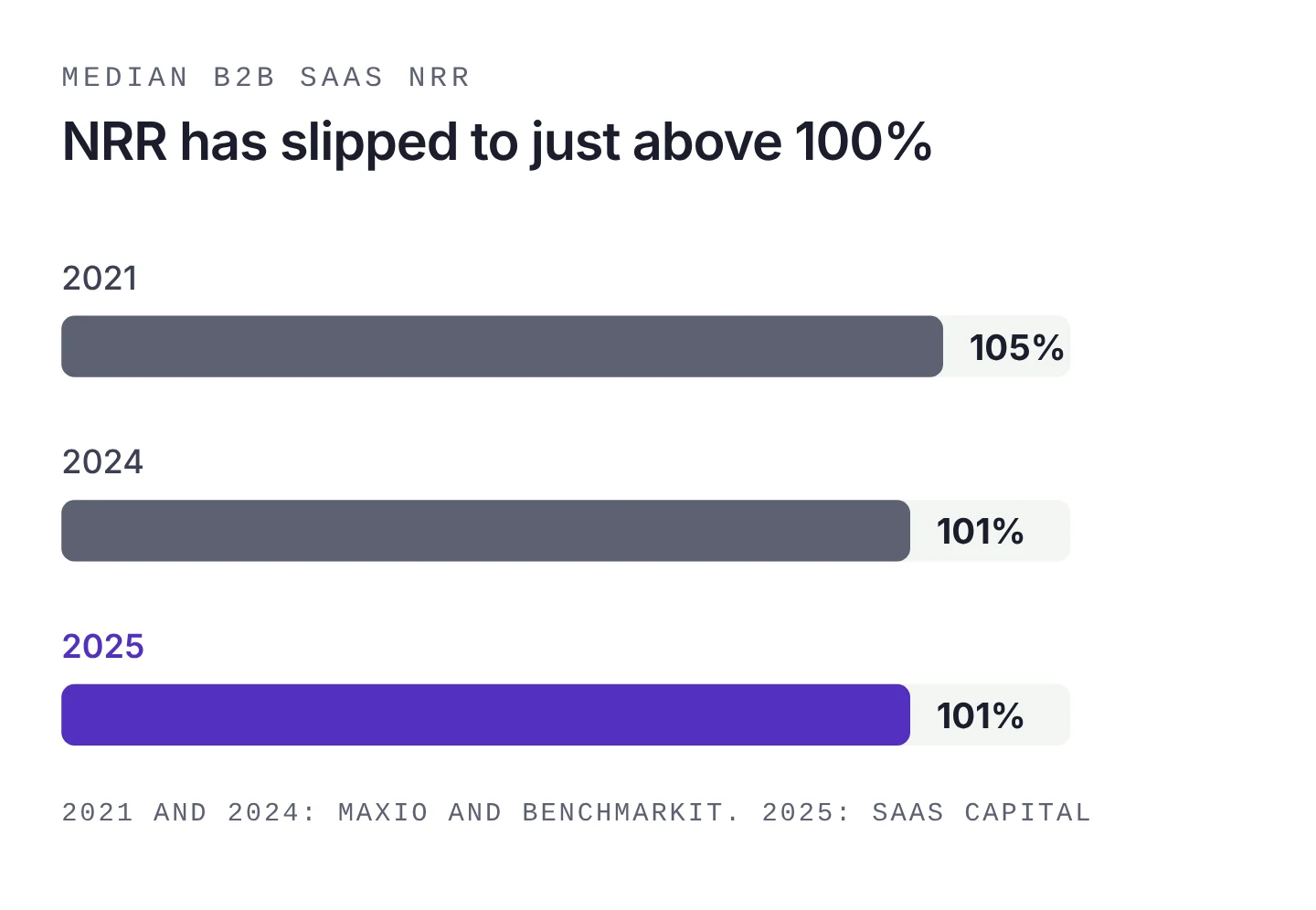
A good NRR is above 100%, and the higher the better. Median B2B SaaS net revenue retention was 101% in 2025 (SaaS Capital, 2025), so the typical company only just keeps what it had: upgrades barely cover what it loses to downgrades and cancellations. It has been falling: NRR fell from 105% in 2021 to 101% in 2024 (Maxio and Benchmarkit).
Small differences above the line matter a lot. SaaS Capital (2025) found that moving NRR from the 100% to 110% band to the 110% to 120% band adds 9 points of growth rate.
| NRR | What it means |
|---|---|
| Below 100% | Your existing customers shrink each year. New sales must replace the loss before the company grows at all. |
| 100% | Upgrades exactly cover downgrades and cancellations. Every new customer is pure growth, but the base doesn't grow on its own. |
| 100% to 110% | Where the median company sits (101% in 2025, SaaS Capital). The base grows a little without new sales. |
| 110% to 120% | The base grows on its own. SaaS Capital (2025): 9 points more growth rate than the 100% to 110% band. |
Compare your number with your own past years first, then with a benchmark. A product sold to small businesses usually loses more customers each year than one sold to large companies with annual contracts, so split your own NRR by customer size before reading anything into it.
NRR vs GRR: what's the difference?
Gross revenue retention (GRR) uses the same formula without expansion: (starting revenue − contraction − churned revenue) ÷ starting revenue. It shows only what you lose, so it can never go above 100%. NRR adds upgrades back in, so NRR is always equal to or higher than GRR.
In the example above, GRR is ($100,000 − $4,000 − $9,000) ÷ $100,000 = 87%, while NRR is 105%. Track both: a high NRR with a low GRR means a few customers growing fast are covering for many leaving, and that rarely lasts.
Where net revenue retention leaks
NRR is one number, but the leaks behind it start at different moments. Some of them happen before a customer is even counted: a customer who signed without reaching value, or upgraded from a trial they barely used, is the one who cancels or downgrades later.
| Stage | Where revenue leaks | What it does to NRR | Where |
|---|---|---|---|
| Onboarding | Signups who never reach value | Unactivated customers churn in their first months | Analytics |
| Trial to paid | Trials that convert without a habit | Weak first-year customers lower next year's NRR | Billing |
| Churn | Cancellations, non-renewals and failed payments | Churned revenue, the biggest subtraction | Billing |
| Expansion | Customers who outgrow their plan but never upgrade | Missing expansion, the only part that adds | Billing |
| Net revenue retentionGoal | All four leaks add up here | Above 100%, the base grows on its own | Billing |
Each stage has its own guide in the series. Start with what SaaS onboarding is and how to build it, the stage where most later churn is decided: Focus Digital (2025) found that 43% of SMB customer losses happen in the first 90 days. Then how to reduce SaaS churn, which covers how to calculate churn rate and the five steps that cut it.
How to improve net revenue retention
Every NRR improvement either lowers the two subtractions or raises the one addition:
- Get new customers to value early. Find the action that predicts a customer who stays, and build onboarding around reaching it in the first weeks.
- Fix failed payments first. Payment retries, failed-payment emails and a card updater recover revenue from customers who never meant to leave, often in a few days' work.
- Watch for accounts going quiet. A weekly health score warns you weeks before the cancellation.
- Give customers a reason to upgrade. Plans and limits that match how customers grow (seats, usage, the features larger teams need), and an in-product prompt at the moment a customer hits a limit.
- Measure by cohort. Compare each signup month's NRR at 12 months. If newer cohorts keep more, the fixes are working.
Most teams fix one leak and watch the problem move to the next: better onboarding brings more customers to the point where pricing stops them growing. That's why we treat net revenue retention as one system, measured once and fixed in order.
How we help
If your NRR is below where you want it and you don't know which leak matters most, our 48-hour diagnostic finds where revenue leaks between signup and renewal, from your own data. When the problem is upgrades, the Feature Gating Sprint builds the upgrade prompts and billing hooks; when onboarding, upgrades and churn all leak at once, the 60-Day Growth Overhaul fixes them as one program. Book a 20-minute call with Jamie to talk it through.
Questions
What is net revenue retention?
Net revenue retention (NRR) is the recurring revenue you keep from a group of existing customers over a period, after upgrades, downgrades and cancellations, as a percentage of what those customers paid at the start. New customers are left out. In SaaS, NRR always means net revenue retention, not the population statistic net reproduction rate.
How do I calculate NRR?
Take the recurring revenue your customers paid at the start of the period, add expansion (upgrades, extra seats, add-ons), subtract contraction (downgrades) and churned revenue (cancellations), then divide by the starting revenue and multiply by 100. Leave out revenue from customers who joined during the period.
What is a good NRR?
Above 100% means your existing customers grow on their own. Median B2B SaaS net revenue retention was 101% in 2025 (SaaS Capital, 2025), so most companies only just clear that line. SaaS Capital also found that moving from the 100% to 110% band to the 110% to 120% band adds 9 points of growth rate.
Which is higher, NRR or GRR?
NRR is always equal to or higher than GRR. Gross revenue retention uses the same formula without expansion, so it can never go above 100%. NRR adds upgrades back in, so it can.
Can NRR be over 100%?
Yes. When upgrades, extra seats and add-ons from existing customers are worth more than what you lose to downgrades and cancellations, NRR is above 100% and your revenue grows even with no new customers.
Is net revenue retention the same as net dollar retention?
Yes. Net dollar retention (NDR) is another name for the same metric, common in investor reports. Check the period and whether a company uses monthly or annual revenue before comparing two numbers.