




A user signs up for your SaaS product. They poke around for three minutes, click a few buttons, and leave. They never come back. You just spent real money acquiring that customer, and they churned before they even understood what your product does.
This scenario plays out thousands of times daily across the software industry. The problem isn't your product - it's the gap between signup and success. That gap is where user onboarding lives, and understanding what user onboarding means for SaaS companies has become the difference between growth and stagnation.
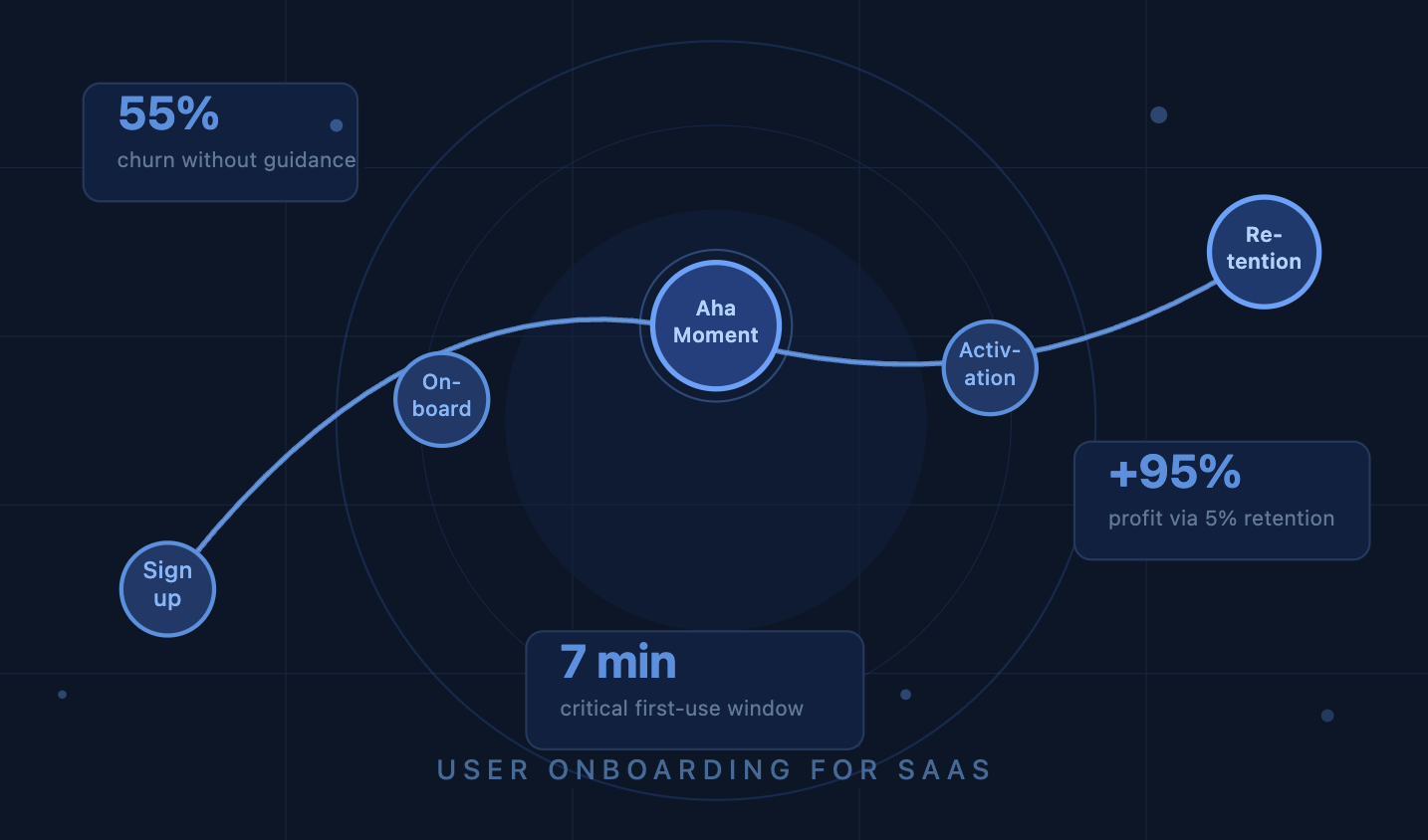
Here's the reality: 55% of customers will stop using a product they don't understand. That's not a marketing problem or a sales problem. It's an onboarding problem. And with the SaaS market projected to reach $317.55 billion by the end of 2024, the companies that master this discipline will capture disproportionate value.
User onboarding in SaaS is the structured process of guiding new users from their first interaction with your product to the moment they experience genuine value. It's not a welcome email. It's not a feature tour. It's an intentional system designed to create successful users as quickly as possible.
The best onboarding experiences feel invisible. Users don't notice they're being guided - they just find themselves accomplishing goals faster than expected. Building that kind of experience requires understanding psychology, product design, and data analysis simultaneously.
User onboarding encompasses every touchpoint between a user's first signup and their transformation into an engaged, paying customer. This includes in-app guidance, email sequences, documentation, support interactions, and the product experience itself.
The business impact is measurable and significant. Poor onboarding creates a leaky bucket where acquisition spending evaporates. Strong onboarding turns that bucket into a flywheel where successful users become advocates who attract more users.
Most SaaS companies obsess over acquisition metrics while neglecting what happens after signup. They'll spend $50 to acquire a user, then lose them to confusion within 48 hours. The math doesn't work, yet the pattern persists because onboarding improvements are harder to measure than ad spend.
For years, SaaS growth meant one thing: more signups. Companies poured resources into marketing funnels, optimized landing pages, and ran endless A/B tests on button colors. The assumption was simple - get enough people through the door, and revenue follows.
That assumption is breaking down. Customer acquisition costs have increased dramatically across most channels. Competition has intensified in nearly every SaaS category. Users have less patience and higher expectations than ever before.
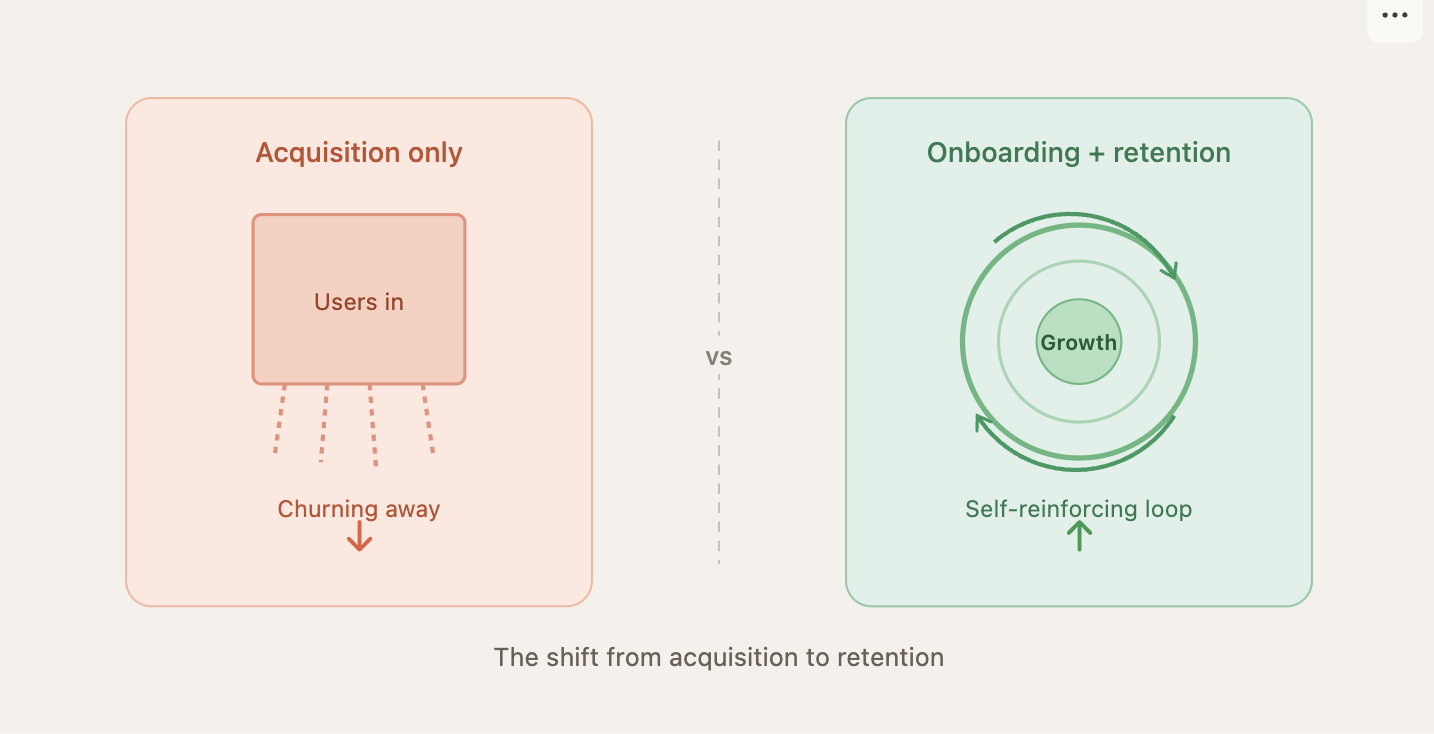
The math now favors retention over acquisition. Increasing retention by just 5% can increase profits by 25% to 95%. That's not a typo - the compounding effect of keeping customers longer dramatically outweighs the marginal gains from acquiring more customers who churn quickly.
This shift explains why onboarding has moved from afterthought to strategic priority. The companies winning in SaaS aren't necessarily acquiring more users - they're keeping more of the users they already have. And that retention starts in the first few minutes after signup.
Smart teams now allocate significant resources to the post-signup experience. They recognize that a user who never activates costs the same to acquire as a user who becomes a power user. The difference is entirely in what happens during onboarding.
Two metrics dominate onboarding conversations: Time to Value and the Aha Moment. Understanding both is essential for building effective onboarding systems.
Time to Value measures how long it takes a new user to experience meaningful benefit from your product. For a project management tool, this might be creating their first project and inviting a teammate. For an analytics platform, it might be generating their first insight. The shorter this time, the more likely users are to stick around.
The Aha Moment is the specific action or realization that transforms a skeptical user into a believer. Facebook famously identified their Aha Moment as connecting with seven friends within ten days. Slack discovered it was sending 2,000 team messages. Your product has an Aha Moment too - you just need to find it.
According to ProductLed.com, the first seven minutes of a user's experience strongly influence retention and conversion. That's not much time to make an impression. Every unnecessary step, confusing interface element, or unclear instruction pushes users closer to abandonment.
Identifying your Aha Moment requires analyzing user behavior data. Look at users who converted to paid plans or became highly engaged. What actions did they take early on? What patterns emerge? The answers reveal what your onboarding should optimize toward.
Once you identify these metrics, you can reverse-engineer your onboarding flow. Every element should either reduce Time to Value or move users closer to their Aha Moment. Anything else is friction that needs removal.
Effective onboarding combines multiple elements working together. No single tactic creates success - it's the orchestration of various touchpoints that guides users to value.
The best onboarding flows share common characteristics: they're contextual, progressive, and personalized. They meet users where they are, reveal complexity gradually, and adapt based on user behavior and stated goals.
Building these flows requires understanding your users deeply. What are they trying to accomplish? What obstacles typically stop them? What information do they need at each stage? The answers inform every design decision.
Product tours have become standard practice for good reason. 92% of top SaaS apps now use in-app onboarding tours, up from 68% in 2020. This dramatic increase reflects growing recognition that users need guidance to succeed.
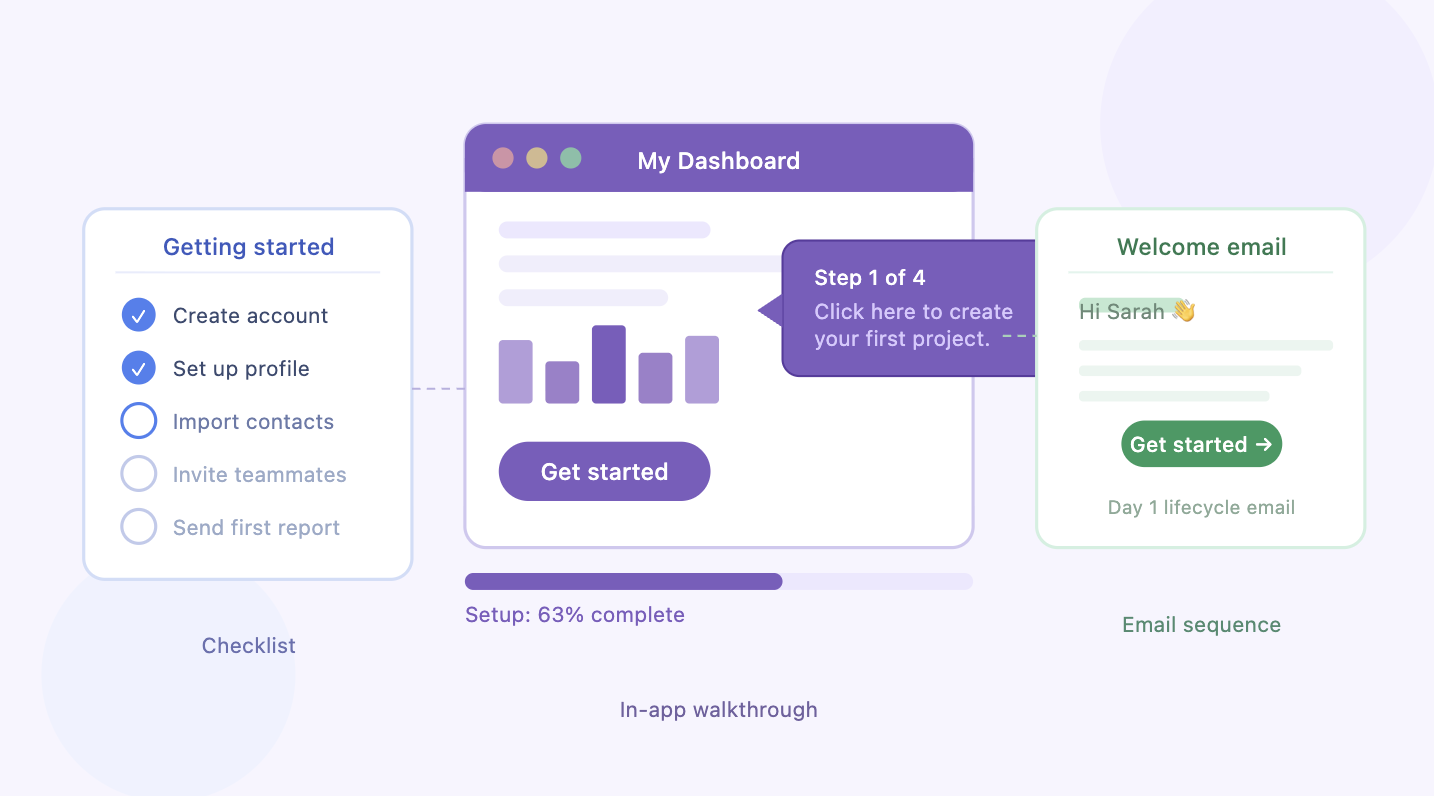
Effective tours share several characteristics. They're triggered contextually rather than dumped on users immediately after signup. They focus on actions rather than features. They're skippable for experienced users but valuable for newcomers.
The worst tours are exhaustive feature dumps that overwhelm users before they've accomplished anything. Showing someone twenty features when they just want to complete one task creates confusion, not clarity.
Better approaches include:
The goal isn't to show users everything your product can do. It's to help them accomplish their immediate goal while building confidence to explore further.
Humans respond to progress indicators. Seeing a checklist with completed items creates satisfaction and motivation to continue. This psychological principle, when applied thoughtfully, significantly improves onboarding completion.
The data supports this approach: apps that incorporate gamification elements like badges and progress bars see 50% higher completion rates. That's a substantial improvement from a relatively simple implementation.
Effective onboarding checklists typically include five to seven items. Fewer feels trivial; more feels overwhelming. Each item should represent a meaningful milestone that moves users closer to value, not arbitrary busywork designed to inflate engagement metrics.
Progress bars work similarly. Showing users they're 60% through setup motivates completion in ways that an open-ended process doesn't. The key is ensuring the remaining steps feel achievable rather than daunting.
Some teams add celebration moments when users complete key actions. A brief animation or congratulatory message reinforces positive behavior without being obnoxious. The tone should match your brand - what works for a playful consumer app differs from what works for enterprise software.
Not all onboarding happens inside your product. Email sequences and in-app messages extend guidance beyond active sessions, re-engaging users who might otherwise drift away.
Lifecycle emails serve multiple purposes during onboarding. They remind users of incomplete setup steps. They highlight features relevant to the user's stated goals. They share tips and best practices. They create urgency around trial expiration or limited-time offers.
The most effective sequences are behavior-triggered rather than time-based. Sending a "complete your profile" email to someone who already completed their profile damages credibility. Modern onboarding tools enable sophisticated segmentation based on actual user actions.
In-app messaging complements email by reaching users when they're actively engaged. These messages can announce new features, offer help when users seem stuck, or celebrate milestones. The key is relevance - messages should feel helpful rather than intrusive.
Timing matters enormously for both channels. Bombarding users with messages creates annoyance. Too few messages leave users without needed guidance. Finding the right frequency requires testing and iteration based on engagement data.
Moving from theory to practice requires a structured approach. Building effective onboarding isn't about implementing random tactics - it's about creating a coherent system aligned with your users' goals and your business objectives.
The process starts with understanding, moves through design, and continues with ongoing optimization. Each phase builds on the previous one. Skipping steps creates fragile systems that fail when user behavior doesn't match assumptions.
Before designing any onboarding elements, you need clarity on the user journey. This means documenting every step from signup to successful adoption, identifying friction points, and defining what success looks like at each stage.
Start by listing every action a user must take to reach value. For a CRM, this might include: create account, import contacts, add first deal, send first email, close first deal. Each action represents a milestone that moves users forward.
Next, identify where users typically drop off. Analytics tools reveal these patterns. You might discover that 40% of users never import contacts, or that users who don't add a deal within 48 hours rarely return. These insights direct where to focus onboarding resources.
The mapping process should answer several questions:
This map becomes your onboarding blueprint. Every tour, email, and tooltip should connect to specific journey stages and milestone actions. Random guidance creates noise; strategic guidance creates progress.
Document your findings visually. Flowcharts or journey maps help teams align on the user experience and identify gaps in current onboarding. They also make it easier to communicate priorities to stakeholders who might not understand the technical details.
Not all users are the same. A marketing manager has different goals than a developer. A solo user has different needs than an enterprise team. Treating everyone identically wastes opportunities for personalization.
Effective segmentation starts during signup. Asking users about their role, goals, or company size enables personalized experiences from the first interaction. The key is asking only what you'll actually use - every additional field reduces completion rates.
Once you have segmentation data, you can customize the entire onboarding experience. Different personas might see different welcome messages, product tours, email sequences, and feature recommendations. The product feels built specifically for them.
Common segmentation approaches include:
The investment in segmentation pays off through higher activation rates and faster time to value. Users who feel understood engage more deeply than users who receive generic guidance.
Implementation complexity varies by approach. Simple segmentation might just customize welcome messages. Sophisticated segmentation might create entirely different product experiences based on user attributes. Start simple and add complexity as you learn what matters.
Even well-intentioned onboarding efforts fail when they fall into predictable traps. Understanding these pitfalls helps you avoid them in your own implementation.
Most onboarding failures stem from misaligned incentives. Teams optimize for metrics that don't correlate with user success. They build what's easy rather than what's effective. They assume they know what users need without validating those assumptions.
The most common onboarding mistake is trying to teach everything at once. Product teams know their software intimately and want users to appreciate its full capability. This enthusiasm creates overwhelming experiences that paralyze rather than empower.
New users have limited cognitive capacity for learning. They're already processing unfamiliar interfaces, new terminology, and uncertain outcomes. Adding lengthy explanations or extensive feature tours exhausts their attention before they accomplish anything meaningful.
The solution is progressive disclosure - revealing information only when it's relevant. Users don't need to know about advanced reporting features during initial setup. They need to know how to complete their first task successfully.
Apply the "just in time" principle to onboarding content. Explain features when users encounter them, not before. Keep initial guidance focused on the single most important action. Trust that users will explore additional features once they've experienced initial value.
Visual design matters too. Dense paragraphs of text trigger avoidance. Short sentences, clear headings, and strategic white space make information accessible. Screenshots and animations often communicate more effectively than words.
Test your onboarding with people unfamiliar with your product. Watch them struggle. Note where they get confused. Their experience reveals blind spots that internal teams can't see because they're too close to the product.
Many teams build onboarding once and never revisit it. They assume initial decisions were correct and move on to other priorities. This approach guarantees suboptimal results because assumptions rarely match reality perfectly.
Effective onboarding requires continuous learning. You need systems to capture what's working and what isn't. This means tracking completion rates for each onboarding step, monitoring where users drop off, and collecting qualitative feedback about user experience.
Quantitative data reveals patterns but not causes. You might see that 30% of users abandon during a specific step without understanding why. Qualitative research fills this gap through user interviews, session recordings, and support ticket analysis.
Build feedback mechanisms directly into your onboarding. Simple surveys asking "Was this helpful?" after key steps provide actionable insights. Support chat widgets let confused users get immediate help while generating data about common obstacles.
The feedback loop should be continuous, not periodic. Set up dashboards that surface onboarding metrics daily. Review user feedback weekly. Make onboarding improvements part of regular product development rather than occasional projects.
Teams that treat onboarding as a living system consistently outperform teams that treat it as a one-time project. The former continuously improve while the latter slowly degrade as products evolve and user expectations change.
What gets measured gets managed. Establishing clear metrics for onboarding success enables data-driven improvement and helps justify continued investment in the function.
The right metrics connect onboarding activities to business outcomes. Vanity metrics like "onboarding tour completion rate" matter less than "percentage of users reaching activation milestone" or "trial-to-paid conversion rate."
Start with the metrics that directly impact revenue. For most SaaS businesses, this means trial-to-paid conversion rate and early-stage churn rate. These numbers reveal whether onboarding is creating successful users who see enough value to pay.
Segment these metrics by cohort to identify trends. Are conversion rates improving over time as you refine onboarding? Do certain user segments convert at higher rates? Which acquisition channels produce users who activate successfully?
Correlation analysis reveals which onboarding actions predict success. You might discover that users who complete a specific action within 24 hours convert at three times the rate of users who don't. This insight should reshape your entire onboarding strategy around driving that action.
Useful metrics to track include:
Build dashboards that make these metrics visible to everyone involved in onboarding. Product managers, designers, marketers, and support teams all benefit from understanding how their work impacts user success.
Compare your metrics against industry benchmarks when available. Understanding whether your 25% trial conversion rate is strong or weak requires context. Benchmarks help set appropriate improvement targets.
Intuition about what works is unreliable. The only way to know whether changes improve outcomes is through controlled experimentation. A/B testing enables confident decisions based on evidence rather than opinion.
Start with high-impact tests. Changing the first screen users see after signup typically has more impact than tweaking the seventh email in a sequence. Focus testing resources where improvements will move metrics meaningfully.
Good A/B tests have clear hypotheses. "Users who see a personalized welcome message will activate at higher rates than users who see a generic message" is testable. "Let's try a different color" isn't a hypothesis - it's random experimentation.
Sample size matters for statistical significance. Small tests produce unreliable results that lead to false conclusions. Calculate required sample sizes before launching tests and wait for sufficient data before declaring winners.
Test one variable at a time when possible. Changing multiple elements simultaneously makes it impossible to know which change drove results. Sequential testing takes longer but produces clearer insights.
Document all tests and results. Over time, this documentation becomes institutional knowledge about what works for your specific users. Patterns emerge that inform future decisions and prevent repeating failed experiments.
The SaaS companies that thrive in the coming years will be those that master the post-signup experience. As acquisition costs rise and competition intensifies, the ability to convert signups into successful, paying users becomes the primary growth lever.
User onboarding for SaaS isn't a feature to implement once and forget. It's a discipline requiring ongoing attention, measurement, and refinement. The companies that treat it as strategic priority will compound their advantages over those that treat it as an afterthought.
Start with understanding your users deeply. Map their journey to value. Identify where they struggle. Build guidance that meets them where they are and moves them toward success. Measure everything. Test relentlessly. Improve continuously.
If you're looking to accelerate this process, working with specialists can shortcut the learning curve. Flow helps SaaS companies build onboarding experiences that activate and convert users while reducing churn. Whether you're optimizing an existing flow or transitioning from sales-led to self-serve onboarding, expert guidance makes the difference between incremental improvement and transformational results.
The gap between signup and success is where SaaS businesses are won or lost. Close that gap, and growth follows.


