Free trial conversion rate is the share of people who start a free trial and then become paying customers within a set time. In 2026, for a trial that doesn't ask for a credit card, 4% to 6% is good and 10% to 15% is great. When a card is required up front, 25% to 35% is good and 50% to 60% is great (ChartMogul Conversion Report, 2026). Those ranges are far apart because the two kinds of trial attract different people, so compare yourself only with the kind you run.
This is the third guide in our revenue leak series, which starts with net revenue retention: the number every leak from signup to renewal adds up to. The guide before it covers what SaaS onboarding is, where trial users first stall. Here we cover the next stage, trial to paid: how to measure it, what good looks like, how free trials, freemium and reverse trials compare, and what gets more trial users to pay.
What is free trial conversion rate?
Free trial conversion rate, also called trial-to-paid conversion, measures how many trial users go on to pay you. The formula is:
Trial-to-paid conversion rate = trial users who became paying customers within the window ÷ trials started in the period × 100
The numbers below are illustrative, for a made-up company. In March, 400 people start a 14-day trial. By the end of the window, 32 of those same people pay. The March conversion rate is 32 ÷ 400 = 8%.
Three choices make the number comparable from month to month:
- Count by cohort. Take everyone who started a trial in one month and follow that group. Dividing this month's new customers by this month's new trials mixes people who started at different times.
- Fix the window. Many users pay after the trial ends, not on its last day. The 2026 ChartMogul survey counted anyone who paid within six months. Pick a window, write it down and keep it.
- Count trial starts, not visitors. Visitor to signup is a separate number. It matters (the credit card section below shows how much), but mixing the two hides where the drop happens.
If you run freemium instead of a trial, the same formula gives free-to-paid conversion: free signups who became paying customers within the window, divided by free signups.
Free trial conversion rate benchmarks (2026)
The most recent benchmark is the ChartMogul Conversion Report, published in February 2026 by Kyle Poyar with ChartMogul and ProductLed. It's a survey of 200 software products, run in January 2026, that measured the share of free signups or trial users who became paying customers within six months. The numbers are self-reported, so read them as ranges, not targets.
| How people try | Good | Great |
|---|---|---|
| Freemium | 3% to 5% | 8% to 12% |
| Free trial, no credit card | 4% to 6% | 10% to 15% |
| Reverse trial | 4% to 6% | 8% to 12% |
| Free trial, credit card required | 25% to 35% | 50% to 60% |
Benchmarks: ChartMogul Conversion Report, 2026. The reverse trial sample was small, and the report notes that its difference from the others "is not statistically significant."
Across every product in the survey, the median free-to-paid conversion rate was 8%. But the spread is wide: the report found "a 10x conversion difference between the top 20% of self-serve products and the bottom 20%." Where you land depends far more on your product and your onboarding than on the model you pick.
Older numbers run higher. A 2023 survey of more than 1,000 products by Kyle Poyar and Lenny Rachitsky (Lenny's Newsletter, with OpenView and Pendo) put a good free trial conversion rate at 8% to 12% and a great one at 15% to 25%, over the same six-month window. Different samples give different ranges, so the most useful comparison is always your own conversion rate, by monthly cohort, over time.
Opt-in or opt-out: should a free trial require a credit card?
An opt-in trial asks for nothing but an email; users opt in to paying at the end. An opt-out trial (card required) takes a card at signup and charges it unless the user cancels. The card raises conversion a lot: in the 2026 survey, 30% of card-required trial users paid, more than 5 times the rate of trials that don't ask for one.
But fewer people start a trial that asks for a card, and the conversion rate only counts the ones who did. Per 1,000 website visitors, the same survey found:
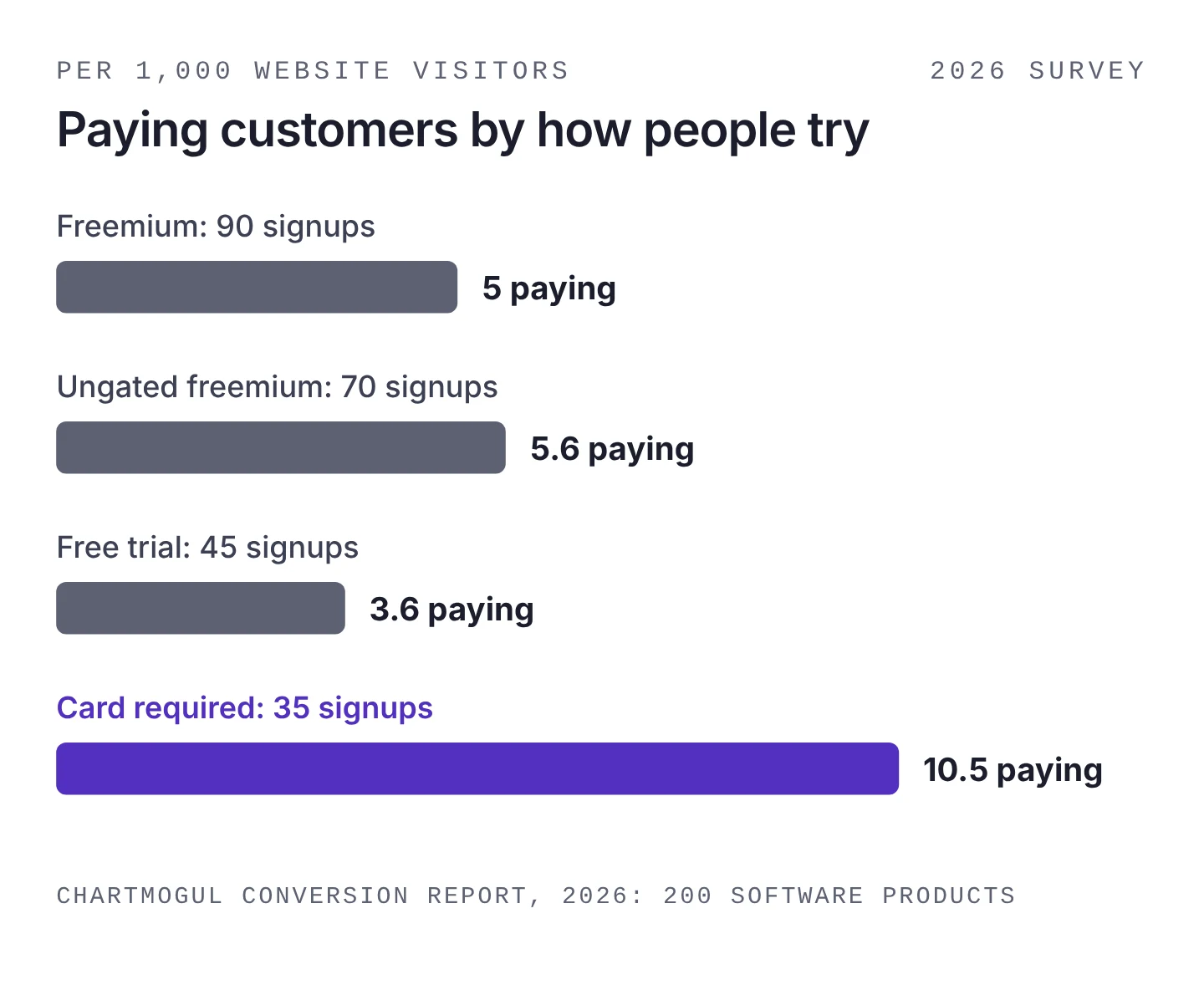
Two things stand out. Card-required trials produced the most paying customers per visitor. And free trials as a whole produced fewer than freemium: in the report's words, "Free trials convert at slightly higher rates than freemium; however, this difference gets wiped out upon accounting for signup rates."
So judge a change on paying customers per visitor, not on the conversion rate alone. Asking for a card will lift trial-to-paid almost by definition. Whether it's right for you depends on two things the conversion rate can't show: how many people you lose at signup, and how many of the customers who paid stay after their first bill. If many cancel as soon as they notice the charge, the conversion was never real, and it turns up later as churn.
Freemium vs free trial vs reverse trial
The free trial is still the most common way to let people try a B2B product. In the 2026 survey, 57% of products led with a free trial, 26% with freemium and 7% with a reverse trial.
| Free trial | Freemium | Reverse trial | |
|---|---|---|---|
| What users get | The full product (or a paid plan) for a fixed time | A free plan with limits, for as long as they like | The paid features for a fixed time |
| When it ends | Pay or lose access | It doesn't; users upgrade when they hit a limit | Pay or move to the free plan |
| What pushes the decision | The deadline | The limit | The deadline, then the limit |
| Works best when | Users can reach value within the trial | The free plan spreads the product (invites, shared work) | Paid features are what makes the product worth it |
Our guide to product-led growth covers how each fits a product-led go-to-market.
What is a reverse trial?
A reverse trial combines the two. Kyle Poyar's definition: "In a reverse trial, new users start with a time-limited trial of your paid features. At the end of the trial, they can either buy or downgrade to a fully free tier."
The idea is that users see what the paid plan does before they decide, and the ones who don't pay stay in the product on the free plan, where they can still upgrade later. Elena Verna, who is testing reverse trials at Dropbox, describes trials that usually start without a card, with users "smoothly transitioned to a freemium plan" when the trial ends without a payment. Her examples include Airtable (a 14-day trial of the team experience, then the free plan unless the user upgrades), Asana (a 30-day trial of the paid plan) and Canva, where new users start on a trial.
A reverse trial isn't a shortcut to higher conversion. The 2026 benchmarks put it between free trials and freemium, on a small sample. It suits a product that already has a free plan worth keeping and paid features users can feel within the trial.
How long should a free trial be?
Most products use 14 days: 62% in the 2026 survey, with 7 days and 30 days at 14% each. The length that's right for you is the time most users need to reach the first result they came for, with room to spare. Measure how long your users take to get there before changing it. A longer trial gives slow users more time; it also gives everyone more time to forget about you.
Why trial users don't convert
A trial converts when the user gets real value from the product before the clock runs out. Most trials that don't convert end without that moment: the user signed up, looked around, met a setup step that took effort, and never came back.
So the first job is to find the step where trial users start getting value, the activation point, and get more of them there early. Our guide to activation metrics shows how to find it from your own data.
A real one from our work: for Timelines.AI, connecting WhatsApp is the step where trial users start getting value. Before our project, 47% of its Zapier trial users connected it. We built onboarding emails for those trial users aimed at that one step, and in the 12 weeks after launch the share rose to 55%.
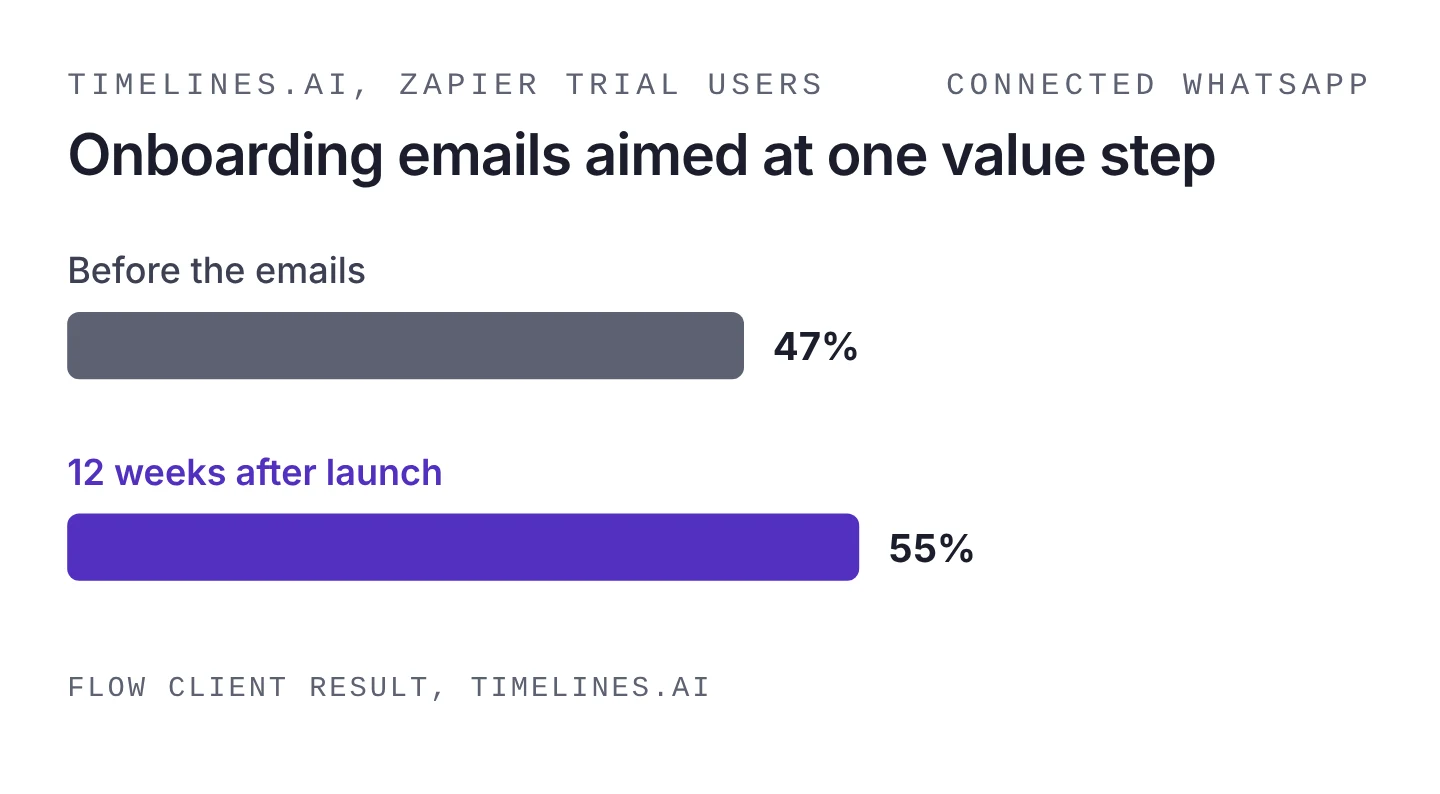
Two things made it work. The emails were about one step, not a tour of features. And they were sent on what each user had or hadn't done, so a user who had already connected WhatsApp didn't get asked to.
The same project showed the other half: a trial that ends unpaid isn't always lost. Our trial win-back emails for Timelines.AI brought back 8 trial users the company had already lost, worth $8K in ARR, within 60 days of launch.
How to improve free trial conversion
- Find the value step. Compare trial users who paid with those who didn't, and find the action that separates them. That's the step everything else points at.
- Shorten the path to it. Cut signup fields you don't use, set sensible defaults, and use sample data or templates so the first screen isn't empty.
- Guide users by what they do. In-product prompts and emails triggered by behavior, pointing at the next step they haven't taken. Our guide to self-serve onboarding has seven practices for this.
- Show what the paid plan does before the end. Users decide better when they've already used the paid features, which is the argument for a reverse trial. In a plain free trial, show what they'll lose a few days before it ends, not on the last day.
- Bring back expired trials. A short sequence after the trial ends, for users who reached value but didn't pay, and an easy way to restart.
- Measure every step, by cohort. Signup to activation, activation to paid, and how long each takes, for each month's trials. Our framework for where B2B SaaS users drop off shows where to look at each stage.
Trial to paid and net revenue retention
Trial-to-paid conversion decides who becomes a customer; it doesn't show whether they stay. A trial user who paid without forming a habit is the customer most likely to cancel or downgrade in the first months, and those losses show up in next year's net revenue retention. That's why we read trial to paid together with early churn. The next guide in the series covers how to reduce SaaS churn, including how to calculate churn rate, and the NRR guide shows where each stage's leak lands in the one number.
How we help
If your trials aren't converting and you don't know where users drop off, our 48-hour diagnostic finds where trial users stall between signup and paid, from your own analytics and billing data. Our Onboarding Sprint builds the fix in 14 business days: in-app guides, emails and tracking in the tools you already use. Book a 20-minute call with Jamie to talk it through.
Questions
What is a good free trial conversion rate?
For a free trial that doesn't ask for a credit card, 4% to 6% of trial users paying within six months is good and 10% to 15% is great. When a credit card is required, 25% to 35% is good and 50% to 60% is great (ChartMogul Conversion Report, 2026, a survey of 200 software products).
How do you calculate trial-to-paid conversion rate?
Take the trials that started in a period, count how many of those same trial users became paying customers within a fixed window, divide by the number of trials started and multiply by 100. Measure each month's trials as a group and keep the window the same every time.
What is a reverse trial?
A reverse trial starts every new user on the paid features for a limited time. When the trial ends, users who haven't paid move to the free plan instead of losing access. Airtable, Asana and Canva have all used versions of it.
Freemium vs free trial, which converts better?
Free trials convert a slightly larger share of their signups, but freemium products get about twice as many signups from the same traffic. Per 1,000 website visitors, the 2026 ChartMogul survey found 5 paying customers for freemium and 3.6 for free trials, and 10.5 for trials that require a credit card.
Should a free trial require a credit card?
Asking for a card cuts signups but raises conversion: 30% of card-required trial users paid in the 2026 ChartMogul survey, against 8% across all free trials. Decide on paying customers per visitor and on how many of them stay after their first bill, not on the conversion rate alone.
How long should a free trial be?
Long enough for most users to reach the step where they first get value, with time to spare. In the 2026 ChartMogul survey, 62% of products used 14 days, 14% used 7 days and 14% used 30 days. Measure how long your own users take to reach value before you change it.